Electronics and Electrical Engineering

Research Associate in Signal Processing for Sensing and Communications
shassan@ed.ac.uk
2.12 Alexander Graham Bell Building
Electronics and Electrical Engineering
Imaging, Data and Communications
Postgraduate
E.E.Bowman@sms.ed.ac.uk
Electronics and Electrical Engineering
Integrated Micro and Nano Systems
Postgraduate
s1837774@sms.ed.ac.uk
3.03 Scottish Microelectronics Centre
Electronics and Electrical Engineering
Integrated Micro and Nano Systems
Lecturer in Superconducting and Cryogenic Electric Machines
hongye.zhang@ed.ac.uk
4.021 Engineering Forum
Electronics and Electrical Engineering
Energy Systems
Image
Hongye ZHANG

Hongye ZHANG (FHEA, MIEEE, MIET) received his BSc and MSc in Electrical Engineering from Xi’an Jiaotong University, Xi’an, China, in 2015 and 2018, respectively, a Diplôme d’ingénieur from École Centrale de Lyon, Lyon, France, in 2018, and his PhD degree in Applied Superconductivity from The University of Edinburgh, UK, in 2021.

In 2021, he was awarded one of the six IEEE Council on Superconductivity Graduate Study Fellowships. He has been working on the £54-million collaborative H2GEAR project as a Research Associate at The University of Manchester since May 2021.

He is currently a Lecturer (Assistant Professor) in Superconducting/Cryogenic Electric Machines at the University of Edinburgh and a Visiting Research Fellow at the University of Manchester.

His research encompasses Design & Analysis & Testing of Superconducting/Cryogenic Electric Machines, Numerical Modelling & Measurement of Superconductors, Hydrogen Energy, and Artificial Intelligence.

He is currently a Board Member of the European Society for Applied Superconductivity (ESAS), a Board Member of the HTS Modelling Workgroup, and an Early Career Editorial Board member & Associate Editor for the Elsevier journal Superconductivity, etc.

He is the Chairman of the international workshop HTS 2026.

  • BSc (2015) and MSc (2018) in Electrical Engineering, Xi’an Jiaotong University, China
  • Diplôme d’ingénieur (MEng, 2018) in General Engineering, École Centrale de Lyon, France
  • PhD (2021) in Applied Superconductivity, The University of Edinburgh, United Kingdom
  • Board Member of The European Society for Applied Superconductivity (ESAS)
  • Board Member of the HTS Modelling Workgroup
  • Early Career Editorial Board Member & Associate Editor of Elsevier Superconductivity (Q1)
  • Programme Committee Member of SMT 2023
  • Technical Editor for IEEE Transactions on Applied Superconductivity, MT-28
  • Guest Editor for a Special Issue of Crystals
  • Winner of the 2021 IEEE Council on Superconductivity Graduate Study Fellowship in Applied Superconductivity
  • Member, IET
  • Member, IEEE
  • BEng - Power Engineering 2
  • MEng - Electrical Machines and Power Electronics (IDCORE)

Hongye ZHANG’s interdisciplinary research combines Electric Machines & Drives, Clean Energy Conversion, Superconductor Technology, Cryogenic Techniques, Hydrogen Energy, and Artificial Intelligence to contribute to low/zero emission technology.

His interests centre on Net Zero Transport and Hydrogen Energy with a focus on power-dense and highly efficient next-generation propulsion electric machines. His current research focuses on the design, analysis, build, and testing of cryogenic/superconducting motors for sub-regional electric aircraft exploiting hydrogen propulsion.

His long-term vision is to build a world-leading research group at the interface of academia and industry that will further advance the decarbonisation of future transport.

  • Numerical modelling of high temperature superconductors
  • Design and analysis of electric machines
  • High-speed propulsion machines for electric aircraft
  • Hydrogen energy application
  • Engineering AI
Postgraduate
s2309335@sms.ed.ac.uk
3.05 Scottish Microelectronics Centre
Electronics and Electrical Engineering
Integrated Micro and Nano Systems
Research Associate
Anabel.martinezlyons@ed.ac.uk
2.2009 James Clerk Maxwell Building
Electronics and Electrical Engineering
Bioengineering
Research Associate in Sensor Data and Resource Management for Autonomous Airborne Platforms
rgan@ed.ac.uk
No Fixed Office
https://runzegan.github.io
Electronics and Electrical Engineering
Imaging, Data and Communications

My research includes methodologies for approximate inference, particularly variational inference and Monte Carlo methods, as well as stochastic modelling for time series data. On the applied side, I primarily work on multi-object tracking, distributed sensor fusion, and intent inference.

I obtained my PhD in Information Engineering from the University of Cambridge, and previously held research associate positions at the Alan Turing Institute and the University of Cambridge.

I have served as a reviewer for international journals and conferences, including IEEE Transactions on Aerospace and Electronic Systems and IEEE Transactions on Signal Processing. I also organised a special session at the IEEE Statistical Signal Processing Workshop 2025.

Personal Chair of Neurotechnology and Medical Electronics
srinjoy.mitra@ed.ac.uk
+44(0)131 6(0)1316507858
G.06b Scottish Microelectronics Centre
Electronics and Electrical Engineering
Integrated Micro and Nano Systems
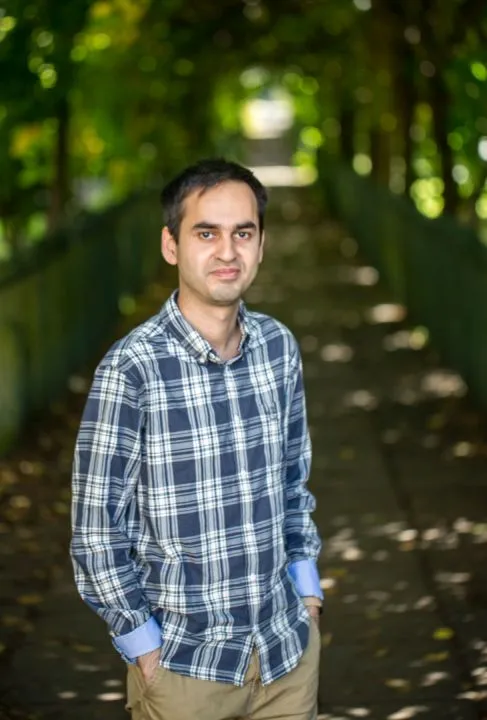
Image
Dr Srinjoy Mitra

Srinjoy Mitra received his B.S. degree in physics and electronics from Calcutta, India and his M.Tech. degree from the Indian Institute of Technology, Bombay, India. After spending a short time in the electronics industry (in India and Japan), he received his Ph.D. from the Institute of Neuroinformatics, ETH Zurich in 2004. Between 2008 and 2010 he worked as a post-doctoral researcher at Johns Hopkins University, Baltimore, USA.

He then joined the medical electronics team at IMEC, Belgium and worked there as a senior scientist until early 2016. At IMEC he had taken up leadership roles in various industrial and public-funded projects primarily related to bio-potential recording. Electro-encephalography (EEG) measurement ICs developed by him have been successfully validated in a clinical environment and is now commercialized. Dr. Mitra also led multiple projects on neural implants for central and peripheral nervous systems. This resulted in the development of generations of CMOS neural recording probes with the highest electrode density. Prof Mitra returned to academia as a Lecturer in the Biomedical Engineering Division at the University of Glasgow. In 2017 he moved to the Integrated Micro and Nano Systems, University of Edinburgh.

Prof Mitra has two parallel research tracks.

His technological research interests are in low-power sensor interfaces, medical/neural electronics, neuromorphic systems and in engineering education. Dr Mitra is the Program Director for the MSc in Sensors and Imaging System. He is also a founding member of Edinburgh Neuroprosthetics Lab.

He is also deeply interested in technological innovation, its global implications, and its pedagogy. This includes a critical analysis of relentless growth in digital technologies and its impact on the planet and people, both historical and in future. He is the convenor of the Decolonisation Working Group in the College of Science and Engineering. Read recent paper here [1],[2],[3].

Post-Docs

Present PhD students

Past team members (PhD and Post-Doc)

Ongoing Projects

Past Projects

  • IMPACT Implantable Microsystems for Personalised Anti-Cancer Therapy
  • SONOPILL Ultrasonic capsule endoscopy
  • Multicorder Point of Care devise for multimodal analysis
  • Smart Stent
  • AQUASENSE

Public Outreach (Podcasts)

  • PhD (Institute of Neuroinformatics, ETH, Zurich)
  • MTech (Indian Institute of Technology, Mumbai)
  • Analog circuit design
  • Technosocial aspects of Engineering
  • Decolonisation in Engineering
Postgraduate
B.Ye-10@sms.ed.ac.uk
1.26 Murchison House
https://bochen-ye.github.io/
https://www.linkedin.com/in/bochen-ye/
Electronics and Electrical Engineering
Integrated Micro and Nano Systems
Image
Bochen's photo

Bochen Ye is currently a first-year PhD student at the Centre for Electronics Frontiers, University of Edinburgh. Before that, he received his Master degree in Eletrical Engneering from Eindhoven University of Technology(TU/e), Netherlands in 2024 and Bachelor degree in Integrated Circuit Design and Integrated Systems from Hefei University of Technology(HFUT), China in 2022. He was a intern at NXP Semiconductor and Intrinsic ID(now part of Synopsys).

PhD student in Engineering - UoE, UK, Now

M.S.(ir.) in EE - TU/e, NL, 2024

B.Eng. in IC design - HFUT, China, 2022

Bochen's research focuses on designing digital hardware acceleration systems for large-scale AI models using novel architectures, aiming to overcome memory and computational bottlenecks. His work emphasizes efficient dataflow, high-performance accelerators, and energy-efficient AI systems on digital ASIC chips. His current focus is on advancing hardware accelerators for LLMs, VLMs, and generative AI to enable next-generation intelligent computing.

Head of Research Institute and Personal Chair in Bioinspired Engineering
Adam.Stokes@ed.ac.uk
+44(0)131 6505611
2.2011 James Clerk Maxwell Building
Electronics and Electrical Engineering
Integrated Micro and Nano Systems
Bioengineering
Image
Professor Adam A Stokes
  • BEng(hons), MRes, PhD
  • Member of the Royal Society of Edinburgh Young Academy of Scotland (MYAS)
  • Programme Director: MSc Electronics