
Image
Climate change is already exacerbating water scarcity bringing uncertainty in the future of the water availability vs. abstraction (water stress), especially in delicate eco-systems. At the same time, industry highly relies on water. In most of the water-demanding industrial sectors high water demand is co-located with high energy demand (water-energy nexus), similarly to countries that benefit from high solar thermal energy (high energy availability) and at the same need water. The co-location of energy in form of heat and water is an opportunity.
In this project, you will research and develop an innovative technology that uses low temperature heat for the production of water with different quality (from drinkable to industry and agriculture) by exploiting recent discoveries in material science and engineering [1, 2]. The technology will be powered by ultralow energy and exploit the temperature differences available in nature: air, soil and natural water (e.g. lakes, seas, rivers).
You will work in the Emerging Sustainable Technologies Laboratory (ESTech Lab) [3], be part of a world leading research group in sustainable technologies towards the development of a proof-of-concept super-efficient processes for heat-powered clean water production (e.g. desalination), have access to state-of-the-art equipment including rapid prototyping tools and brainstorm new technological avenues for clean water production.
Your studies will be carried out at the Institute for Materials and Processes (IMP) and will include modelling activities supported by experiments. You will attain skills in modelling, design and testing of innovative technologies for clean water production.
Please note, the position will be filled once a suitable candidate has been identified.
[1] https://patentscope.wipo.int/search/en/detail.jsf?docId=WO2025003650&_cid=P20-MAL3RA-15255-1
Minimum entry qualification - an Honours degree at 2:1 or above (or International equivalent) in a relevant science or engineering discipline, possibly supported by an MSc Degree.
Further information on English language requirements for EU/Overseas applicants.
Desirable criteria:
A number of scholarships are available to competitive candidates. For more information on the funding application process, please contact the project’s supervisor or visit the School of Engineering website.
Applications are also welcomed from self-funded students.
Are you interested in pursuing a PhD at the University of Edinburgh? We seek a highly motivated student to join an ongoing, industry-linked research programme on fibre-alignment technologies to produce truly circular composites. Complementing process-development efforts in the parent project, you will work within an interdisciplinary team to quantify process metrics and undertake parametric tuning and sustainability evaluation.
The circular fibre products emerging from the parent project are intended to integrate within the existing composites value chain and deliver strong fibre-matrix interfacial performance. Drawing on manufacturing, sustainability, materials science and process-engineering insights, your research will inform targeted process refinement efforts within the wider research programme towards addressing current industrial pain points (high energy footprint and low productivity).
Collaborative links with Gen 2 Carbon, Sigmatex and Teijin Europe in the parent project provide exciting opportunities for knowledge-exchange activities and technical site visits during the project.
Project Objectives
Early application is advised as the position will be filled once a suitable candidate is identified.
Training
As a PhD student, you will take part in a wide range of research activities, including collaboration with international researchers and participation in conferences, workshops and seminars. You will work closely with fellow researchers within the Institute for Materials and Processes (IMP) at the University of Edinburgh’s School of Engineering. Regular meetings and collaborative interactions across the group will provide valuable opportunities for technical exchange and peer learning.
You will have access to tailored professional development opportunities through the Institute for Academic Development, and technical training will be provided as needed to support your experimental and analytical work. Close alignment with the parent project and its industry partners will facilitate site visits and knowledge exchange activities, enhancing the real-world relevance of your research.
Note that only applications via the University’s online system will be considered. All applications should include the following documents:
• For any enquiries, please contact: Dr Winifred Obande (w.obande@ed.ac.uk)
• The University of Edinburgh is committed to equality of opportunity for all its staff and students and promotes a culture of inclusivity. Details: https://www.ed.ac.uk/equality-diversity
• Supervisor home page https://eng.ed.ac.uk/about/people/dr-wini-obande
Minimum entry qualification - an Honours degree at 2:1 or above (or International equivalent) in a relevant science or engineering discipline, possibly supported by an MSc Degree. Further information on English language requirements for EU/Overseas applicants.
We welcome applications from enthusiastic, self-driven and resourceful candidates with a first-class or upper 2:1 UK Honours degree (or international equivalent) in one of the following disciplines:
Other Essential Requirements:
Desirable Requirements:
Further information and other funding options.
There is no funding available for this project, and no additional financial support can be provided. Only self-funded applicants will be considered. If you have your own funding (including government sponsorships), we warmly encourage you to apply.
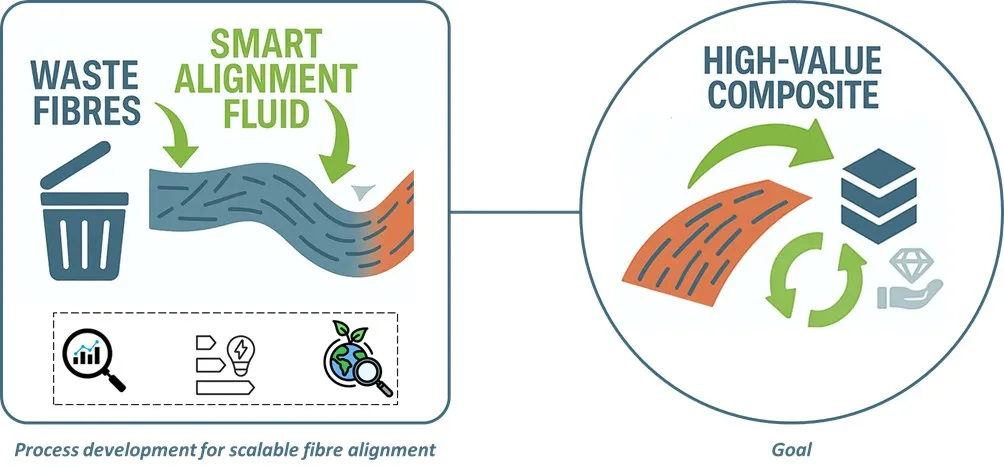
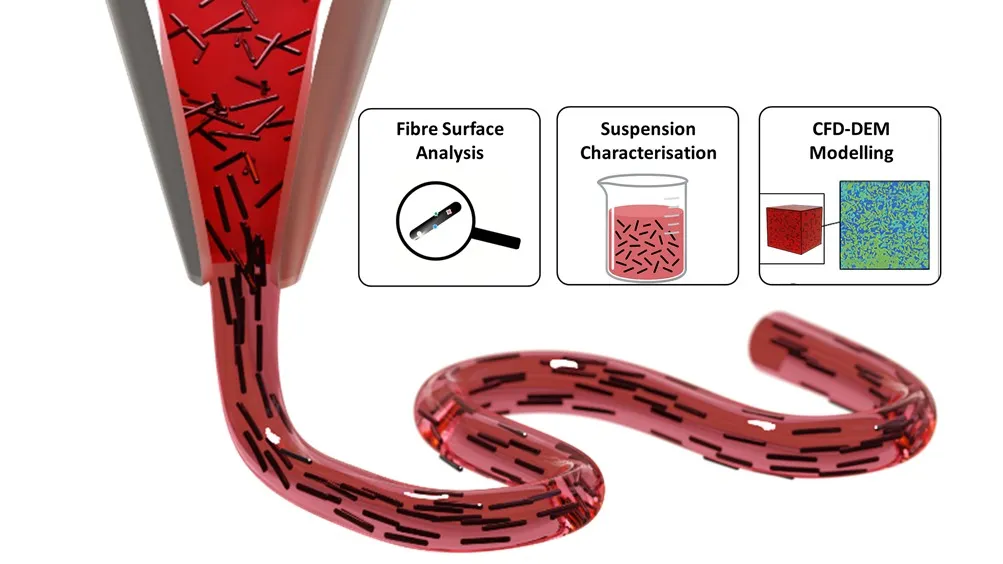
The composites industry is under increasing pressure to transition towards a truly circular economy. As growing demand continues to widen the supply gap, we must recover untapped value that would otherwise be lost to landfilling and incineration, which are resource-intensive and environmentally damaging end-of-life pathways. Where recycled fibres are used, they are often downcycled as fillers and low-value reinforcements in their short and randomly aligned form. A key challenge to the effective reintegration of recycled carbon and glass fibres into high-performance products lies in achieving scalable and energy-efficient fibre alignment from irregular, reclaimed feedstocks. Fibre surface attributes and suspension behaviour in alignment systems play vital roles in determining the alignment efficiency, process stability, and the downstream consolidation and performance of remanufactured composites.
This fully-funded PhD project fits within a wider research programme with industrial partners and an interdisciplinary team working on the development of cross-platform alignment technologies that integrate material science, process engineering and sustainability analysis to deliver scalable solutions for circular composites manufacturing. The successful candidate will contribute to this broader vision by investigating the surface characteristics and suspension dynamics of recycled short fibres used in alignment processes.
Collaborative links with Gen 2 Carbon, Sigmatex and Teijin Europe in the parent project provide exciting opportunities for knowledge-exchange activities and technical site visits throughout the project.
Project Objectives
Early application is advised as the position will be filled once a suitable candidate is identified.
Training
As a PhD student, you will take part in a wide range of research activities, including collaboration with international researchers and participation in conferences, workshops and seminars. You will work closely with fellow researchers within the Institute for Materials and Processes (IMP) at the University of Edinburgh’s School of Engineering. Regular meetings and collaborative interactions across the group will provide valuable opportunities for technical exchange and peer learning.
You will have access to tailored professional development opportunities through the Institute for Academic Development, and technical training will be provided as needed to support your experimental and analytical work. Close alignment with the parent project and its industry partners will facilitate site visits and knowledge exchange activities, enhancing the real-world relevance of your research.
Note that only applications received via the University’s online system will be considered. All applications should include the following documents:
• For any enquiries, please contact: Dr Winifred Obande (w.obande@ed.ac.uk)
• The University of Edinburgh is committed to equality of opportunity for all its staff and students and promotes a culture of inclusivity. Details: https://www.ed.ac.uk/equality-diversity
• Supervisor home page https://eng.ed.ac.uk/about/people/dr-wini-obande
Minimum entry qualification - an Honours degree at 2:1 or above (or International equivalent) in a relevant science or engineering discipline, possibly supported by an MSc Degree. Further information on English language requirements for EU/Overseas applicants.
We welcome applications from motivated, curious, and technically capable individuals with a first-class or upper 2:1 UK Honours degree (or international equivalent) in one of the following disciplines:
Other Essential Requirements:
Desirable Requirements:
Further information and other funding options.
Tuition fees and stipend are available for Home and International students.
Applications are also welcome from self funded students, or students who are applying for scholarships from the University of Edinburgh or elsewhere.
Existing buildings entail a third of the energy consumption in the world and contribute a similar share of greenhouse gas emissions. At the same time, they have been shown to have a large potential for improvement in both fronts. Just enhancing operations of what is already in place is estimated to reduce energy and operational emissions by 20% on average.
A significant area of work has focused on whole-building analysis and simulation to rigorously understand performance of existing assets. Here, building audits are combined with holistic physics-based models to improve understanding of what is built and to devise ways to improve operations and retrofit packages. However, such an approach requires specialist knowledge and can easily become onerous given time, interrelationships of physical processes, and resources needed. In addition, it does not link well with metering and building management systems buildings have in place as they only monitor buildings partially.
This project seeks to investigate the role of progressive energy modelling to assist facility managers understand and improve the performance of existing assets. Building systems can be modelled in a wide range of ways, and it is possible to isolate components for dedicated analyses. Then, they can be extended to include further parts relevant to the system. As an example in HVAC systems, heating/cooling generation via heat pumps or boilers could be analysed with a dedicated model, aided by monitoring points typically implemented, like supply/return temperatures or partial loads. Once it is verified that the system works as expected, the model can be extended to represent further parts of the whole system, like losses in distribution systems, emitters, or links with ventilation systems.
Compared to whole-building simulation, this is a bottom-up modelling approach that conceives buildings as a jigsaw of systems that have a closer correspondence with established monitoring practices in facility management. It simplifies complexity, offers faster feedback cycles, retains meaning to explore alternative ways of operating buildings, and could be done in a way that paves the way to whole-building modelling as required.
We are seeking applicants wishing to advance the state of the art in this area, including exploring the role of model complexity, model interoperability, and influence on facility managers' decision-making processes.
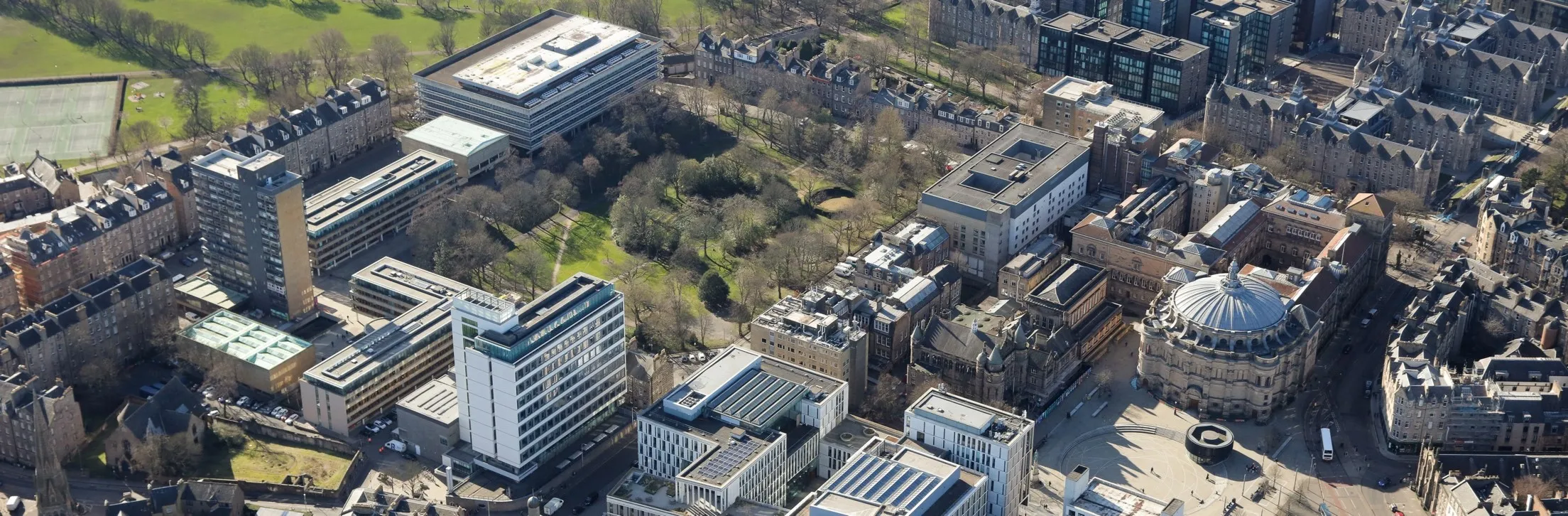
This is a joint PhD project between The University of Edinburgh (Dr Daniel Fosas) and Heriot-Watt University (Professor David Jenkins). The context of the work will be the campuses of these institutions and students will have access to their combined training opportunities.
We welcome applications from all qualified candidates, and we wish to particularly encourage applications from groups underrepresented at this level.
To apply to this opportunity, you will need to:
We are available to discuss and give feedback to applicants that meet entry requirements.
A comprehensive training programme will be provided comprising both specialist scientific training and generic transferable and professional skills. The PhD candidate will be introduced to comprehensive training options, within The University of Edinburgh and Heriot-Watt University.
The candidate will have the opportunity to become a teaching assistant following formal training, as well as opportunities to contribute to wider training and outreach activities. Further training in both academic and interdisciplinary skills will be available as part of Edinburgh’s Institute for Academic Development.
Minimum entry qualification - an Honours degree at 2:1 or above (or International equivalent) in a relevant science or engineering discipline, possibly supported by an MSc Degree.
A background related to building performance simulation and building services engineering would be an advantage for the project. The project will require development of building simulation models, off-the-shelve and bespoke ones, and data mining: familiarity or willingness to learn programming languages like Python, Julia, or R will be essential
Please click on this link for further information on English language requirements for EU/Overseas applicants.
Applications are welcomed from self-funded students, or students who are applying for scholarships from the University of Edinburgh or elsewhere.
Whether it is the substantial cooling requirements of future data centres or energy-dense batteries for next-generation electric vehicles, the need for energy-efficient electronics cooling systems is ubiquitous. This is because while recent developments have produced ever-smaller and ever-denser devices, heat fluxes comparable to the surface of the Sun can be generated at hot spots, producing high temperatures that adversely impact their performance and raise risk of catastrophic failure. In the last decade and a half, novel 2D nanomaterials have been developed with unique thermal properties (e.g. ultrahigh thermal conductivity). These nanomaterials can be used to form surface coatings to enhance heat transfer from the extremely hot surfaces of electronic devices into the adjacent coolant liquid.
However, our understanding of thermal transport at this nanomaterial/liquid interface is currently limited. For 2D nanocoatings, the nanomaterial can be either carbon-based (graphene nanoparticles or nanoflakes, nanopores, graphene oxide nanosheets etc), boron-based (boron nitride nanosheets, nanotubes, etc) or hybrid (e.g. boron carbon nitride). Similarly, while water is the most studied coolant liquid, realistic applications involve dielectric fluids (e.g. benzene, pentane). Molecular dynamics (MD) simulations represent a powerful tool to study such interfaces, but MD of nanomaterial/liquid interfaces require well-calibrated intermolecular potentials, which don’t currently exist. This project will rely on recent advances in neural networks to develop machine learning potentials (MLPs) for MD simulations of realistic nanomaterial/coolant-liquids and use these to gain fundamental insights into interfacial thermal transport. The goals are to:
1) run ab-initio molecular simulations to sample relevant nanomaterial/liquid interfaces.
2) construct new MLPs by using generated data from 1) and validate them.
3) use MLPs to run classical MD simulations and characterise thermal transport.
This PhD project will be based within the School of Engineering, University of Edinburgh. This PhD project will be supervised by Dr Rohit Pillai and Dr Eleonora Ricci, and the successful applicant will join an active, friendly, and collaborative research group (see https://multiscaleflowx.github.io/). Our group makes extensive use of ARCHER2 – the UK’s national supercomputer, which is based in Edinburgh. This PhD will give the successful applicant the skills and experience to become a future leader in either academia or industry. The supervisors will provide the successful applicant with exceptional research and training opportunities, including:
• regular weekly meetings to discuss the research progress.
• opportunities for travel to participate in workshops/summer schools dedicated to advanced computational methods, as well as present results in international conferences.
• training and experience in state-of-the-art engineering research.
• mentoring from other investigators and experienced postdoctoral researchers.
• exceptional career development opportunities with strong institutional support of early career researchers.
Minimum entry qualification - an Honours degree at 2:1 or above (or International equivalent) in a relevant science or engineering discipline, possibly supported by an MSc Degree. Further information on English language requirements for EU/Overseas applicants.
Tuition fees + stipend are available for Home/EU and International students