Image

Are you eager to push the frontiers of fluid dynamics and AI to tackle real-world challenges in crowd safety, urban planning, and event management? Join our EPSRC-funded project FLOCKS (Fluid dynamics-Like Open-source Crowd Knowledge-driven Simulator) as a PhD student and help shape the future of crowd modelling.
FLOCKS aims to develop the world's first real-time, open-source simulator of large, dense crowd dynamics for both academic and industrial applications.
Your research will focus on creating a continuum-based fluid dynamics model of human crowds, treating them as "thinking fluids" and using coarse-grained observables, such as density, mean velocity, and stress-like quantities, as descriptors. Drawing on active matter modelling, you will explore ways of incorporating the non-local perception and decision-making of pedestrians into constitutive relationships and boundary conditions with the aim of capturing realistic crowd behaviour. Where possible, you will also explore coupling the crowd model with hazards such as the spread of smoke and fire during incidents, contagion in pandemics, or violence in demonstrations, which will enable a multi-risk approach to assessment and decision support in high-stakes scenarios.
You will work closely with a postdoctoral researcher to develop complementary data-driven approaches that use machine learning to inform, parameterise and validate crowd dynamics models. This collaboration will establish a continuous feedback loop to refine your model and provide valuable opportunities for knowledge exchange.
You will implement the final model in an open-source simulation environment, and your final demonstrator will simulate iconic Edinburgh events (e.g. Hogmanay on Princes Street, an Edinburgh derby football match, or a Murrayfield Stadium concert) using pre-captured datasets to showcase the predictive capabilities of the simulator.
Thanks to our partnerships with world-leading experts in crowd safety engineering and open-source software development, your work will directly impact public safety, urban planning and event management in the real world.
Early application is advised as the position will be filled once a suitable candidate is identified.
It is intended that the PhD start date will be 1 September 2026, and applicants should select that entry point when applying to the PhD programme.
Minimum entry qualification
Further information on University’s English language requirements for EU/Overseas applicants.
Desirable criteria
Further information and other funding options.
School of Engineering stipend for 3.5 years, home or overseas fees, £5k research costs (over the duration of the project). The stipend rate for academic year 2025/26 is £21,935.
The design of all chemical process starts from mathematical modelling and computational thermodynamics. The reliability of a thermodynamic model in predicting or correlating phase equilibria depends strongly on the value its parameters. Carefully evaluated parameters enable a precise calculation of the phase equilibria and of the process units, affecting as a consequence the costs of a chemical process.
In several cases, the thermodynamic parameters commonly used in process simulators are wrong. They do not return a comprehensively right equilibrium.
The project focuses on the development of an open tool for the correct regression and correlation of thermodynamic data in robust mathematical models. The project involves the development and use of optimization techniques. Special modelling, including Bayesian regression or similar techniques, will be also used.
In this project, you will design digital open and user-friendly tools that can easily integrate with existing process simulators (e.g. AspenPlus, Unisim) and exploit recent advanced algorithms [1, 2]. The ambition of this project is to earn the sector’s support and enable the widespread use of the tool in place of the current unreliable counterparts.
You will work in the Emerging Sustainable Technologies Laboratory (ESTech Lab) [3], be part of a world leading research group in sustainable technologies towards the development of the first robust tool for thermodynamic model identification and calibration, have access to state-of-the-art computing facilities and brainstorm new digital tools across all thermodynamic problems.
Your studies will be carried out at the Institute for Materials and Processes (IMP) and could include occasional experiments to validate models. You will attain skills in modelling, design and testing of innovative digital tools.
Please note, the position will be filled once a suitable candidate has been identified.
[1] https://www.sciencedirect.com/science/article/pii/S037838121400226X
[2] https://www.sciencedirect.com/science/article/pii/S0378381220300297
Minimum entry qualification - an Honours degree at 2:1 or above (or International equivalent) in a relevant science or engineering discipline, possibly supported by an MSc Degree. As well as:
Further information on English language requirements for EU/Overseas applicants.
Desirable criteria:
A number of scholarships are available to competitive candidates. For more information on the funding application process, please contact the project’s supervisor or visit the School of Engineering website.
Applications are also welcomed from self-funded students.
The design of the forthcoming future is negative in emissions. Among the negative emission technologies options, those capturing CO2 directly from the air are called Direct Air Capture technologies. Direct Air Capture technologies are regarded as the solution having the biggest carbon removal potential but is also the least known. If Direct Air Capture had to be an essential measure, future society would deal with severe restrictions in energy availability [1].
However, using the captured atmospheric CO2 for conversion into chemicals and fuels has the right scale not to impinge in the energy system and attractive economic outlook.
In your studies you will work in the Emerging Sustainable Technologies Laboratory (ESTech Lab) [2], be part of a world leading research group in carbon capture towards the development of technological avenues for Direct Air Capture and Conversion into chemicals and fuels.
Your studies will be carried out at the Institute for Materials and Processes (IMP) and will include modelling activities. You will attain skills in modelling and design of new negative emission technologies and production paths.
Please note, the position will be filled once a suitable candidate has been identified.
[1] Santori et. al. Adsorption artificial tree for atmospheric carbon dioxide capture, purification and compression, Energy 162 (2018) 1158-1168. https://doi.org/10.1016/j.energy.2018.08.090
Minimum entry qualification - an Honours degree at 2:1 or above (or International equivalent) in a relevant science or engineering discipline, possibly supported by an MSc Degree. As well as:
Further information on English language requirements for EU/Overseas applicants.
Desirable criteria: knowledge of optimization methods.
A number of scholarships are available to competitive candidates. For more information on the funding application process, please contact the project’s supervisor or visit the School of Engineering website.
Applications are also welcomed from self-funded students.
Digital tools are omnipresent and their rise exponential. Cloud and digital services have improved our lives and, overall, reduced carbon emissions, although at the expense of a growing electricity demand from data centres. Remarkably, nearly half the data centre electricity input is for self-cooling, which provides an opportunity for a technology able to harness low-grade heat and turn it into cooling power. The co-location of energy in form of heat and water is an opportunity.
The project focuses on the mathematical modelling and optimization of a proof-of-principle heat-powered cooling process that reduces waste heat and greenhouse gas emissions and boosts return on investment, while meeting all the sustainability criteria.
Special modelling, including machine learning, and cost of manufacturing tools guide the development of an optimised heat-to-cold concept designed to break through current barriers to commercialisation.
In this project, you will design digital tools for an innovative technology that uses low temperature heat for the production of cold by exploiting recent discoveries in material science and engineering [1, 2]. The ambition of this project is to earn the sector’s support and enable the widespread use of heat-powered cooling in place of the current electricity-driven counterpart.
You will work in the Emerging Sustainable Technologies Laboratory (ESTech Lab) [3], be part of a world leading research group in sustainable technologies towards the development of a proof-of-concept super-efficient processes for heat-powered cooling, have access to state-of-the-art computing facilities and brainstorm new technological avenues for cooling.
Your studies will be carried out at the Institute for Materials and Processes (IMP) and could include occasional experiments to validate models. You will attain skills in modelling, design and testing of innovative technologies for cooling.
Please note, the position will be filled once a suitable candidate has been identified.
[1] https://onlinelibrary.wiley.com/doi/full/10.1002/ente.202300548
Minimum entry qualification - an Honours degree at 2:1 or above (or International equivalent) in a relevant science or engineering discipline, possibly supported by an MSc Degree. As well as:
Further information on English language requirements for EU/Overseas applicants.
Desirable criteria:
A number of scholarships are available to competitive candidates. For more information on the funding application process, please contact the project’s supervisor or visit the School of Engineering website.
Applications are also welcomed from self-funded students.
Digital tools are omnipresent and their rise exponential. Cloud and digital services have improved our lives and, overall, reduced carbon emissions, although at the expense of a growing electricity demand from data centres. Remarkably, nearly half the data centre electricity input is for self-cooling, which provides an opportunity for a technology able to harness low-grade heat and turn it into cooling power. The co-location of energy in form of heat and water is an opportunity.
The project focuses on the design and demonstration of a proof-of-principle 3D printed heat-powered cooling device that reduces waste heat and greenhouse gas emissions and boosts return on investment, while meeting all the sustainability criteria.Special characterisation techniques and additive manufacturing tools guide the development of a geometrically-optimised heat-to-cold concept which is designed to break through current barriers to commercialisation.
In this project, you will research and develop an innovative technology that uses low temperature heat for the production of cold by exploiting recent discoveries in material science and engineering [1, 2]. The ambition of this project is to earn the sector’s support and enable the widespread use of heat-powered cooling in place of the current electricity-driven counterpart.
You will work in the Emerging Sustainable Technologies Laboratory (ESTech Lab) [3], be part of a world leading research group in sustainable technologies towards the development of a proof-of-concept super-efficient processes for heat-powered cooling, have access to state-of-the-art equipment including rapid prototyping tools and brainstorm new technological avenues for cooling.
Your studies will be carried out at the Institute for Materials and Processes (IMP) and will include modelling activities supported by experiments. You will attain skills in modelling, design and testing of innovative technologies for cooling.
Please note, the position will be filled once a suitable candidate has been identified.
[1] https://onlinelibrary.wiley.com/doi/full/10.1002/ente.202300548[2] https://pubs.acs.org/doi/10.1021/acs.est.9b06037[3] https://www.linkedin.com/in/giulio-santori-a365546/
Minimum entry qualification - an Honours degree at 2:1 or above (or International equivalent) in a relevant science or engineering discipline, possibly supported by an MSc Degree. As well as:
Further information on English language requirements for EU/Overseas applicants.
Desirable criteria:
A number of scholarships are available to competitive candidates. For more information on the funding application process, please contact the project’s supervisor or visit the School of Engineering website.
Applications are also welcomed from self-funded students.
Climate change is already exacerbating water scarcity bringing uncertainty in the future of the water availability vs. abstraction (water stress), especially in delicate eco-systems. At the same time, industry highly relies on water. In most of the water-demanding industrial sectors high water demand is co-located with high energy demand (water-energy nexus), similarly to countries that benefit from high solar thermal energy (high energy availability) and at the same need water. The co-location of energy in form of heat and water is an opportunity.
In this project, you will research and develop advanced dynamic mathematical models of an innovative technology that uses low temperature heat for the production of water with different quality (from drinkable to industry and agriculture). The technology will be powered by ultralow energy and exploit the temperature differences available in nature: air, soil and natural water (e.g. lakes, seas, rivers).
You will work in the Emerging Sustainable Technologies Laboratory (ESTech Lab) [1], be part of a world leading research group in sustainable technologies towards the development of user-friendly (Graphical User Interface) advanced model for the characterization and prediction of the dynamic performance of heat-powered clean water production (e.g. desalination), have access to state-of-the-art computing facility and brainstorm new technological avenues for clean water production.
Your studies will be carried out at the Institute for Materials and Processes (IMP) and will include short experimental activities to validate your models. You will attain skills in modelling, design of innovative technologies for clean water.
Please note, the position will be filled once a suitable candidate has been identified.
Minimum entry qualification - an Honours degree at 2:1 or above (or International equivalent) in a relevant science or engineering discipline, possibly supported by an MSc Degree. As well as:
Further information on English language requirements for EU/Overseas applicants.
Desirable criteria: knowledge of computational thermodynamics of fluid phase equilibria or physical chemistry.
A number of scholarships are available to competitive candidates. For more information on the funding application process, please contact the project’s supervisor or visit the School of Engineering website.
Applications are also welcomed from self-funded students.
Climate change is already exacerbating water scarcity bringing uncertainty in the future of the water availability vs. abstraction (water stress), especially in delicate eco-systems. At the same time, industry highly relies on water. In most of the water-demanding industrial sectors high water demand is co-located with high energy demand (water-energy nexus), similarly to countries that benefit from high solar thermal energy (high energy availability) and at the same need water. The co-location of energy in form of heat and water is an opportunity.
In this project, you will research and develop an innovative technology that uses low temperature heat for the production of water with different quality (from drinkable to industry and agriculture) by exploiting recent discoveries in material science and engineering [1, 2]. The technology will be powered by ultralow energy and exploit the temperature differences available in nature: air, soil and natural water (e.g. lakes, seas, rivers).
You will work in the Emerging Sustainable Technologies Laboratory (ESTech Lab) [3], be part of a world leading research group in sustainable technologies towards the development of a proof-of-concept super-efficient processes for heat-powered clean water production (e.g. desalination), have access to state-of-the-art equipment including rapid prototyping tools and brainstorm new technological avenues for clean water production.
Your studies will be carried out at the Institute for Materials and Processes (IMP) and will include modelling activities supported by experiments. You will attain skills in modelling, design and testing of innovative technologies for clean water production.
Please note, the position will be filled once a suitable candidate has been identified.
[1] https://patentscope.wipo.int/search/en/detail.jsf?docId=WO2025003650&_cid=P20-MAL3RA-15255-1
Minimum entry qualification - an Honours degree at 2:1 or above (or International equivalent) in a relevant science or engineering discipline, possibly supported by an MSc Degree.
Further information on English language requirements for EU/Overseas applicants.
Desirable criteria:
A number of scholarships are available to competitive candidates. For more information on the funding application process, please contact the project’s supervisor or visit the School of Engineering website.
Applications are also welcomed from self-funded students.
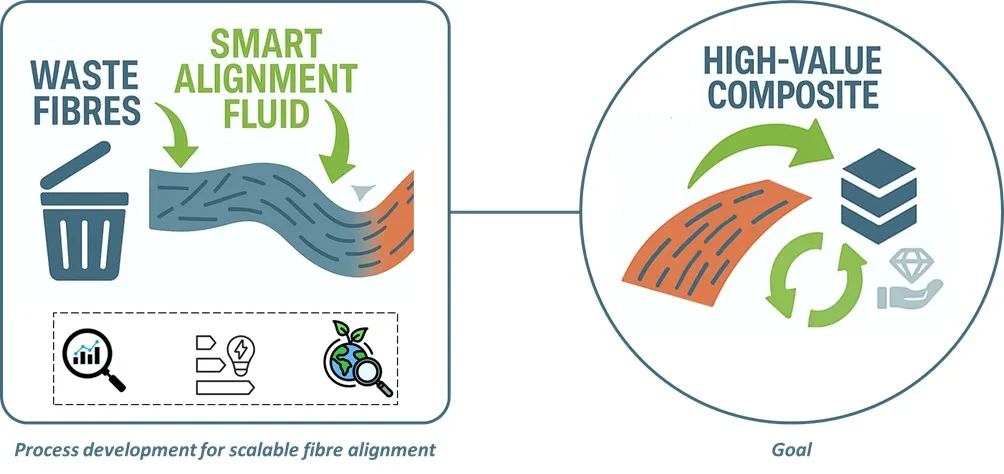
Are you interested in pursuing a PhD at the University of Edinburgh? We seek a highly motivated student to join an ongoing, industry-linked research programme on fibre-alignment technologies to produce truly circular composites. Complementing process-development efforts in the parent project, you will work within an interdisciplinary team to quantify process metrics and undertake parametric tuning and sustainability evaluation.
The circular fibre products emerging from the parent project are intended to integrate within the existing composites value chain and deliver strong fibre-matrix interfacial performance. Drawing on manufacturing, sustainability, materials science and process-engineering insights, your research will inform targeted process refinement efforts within the wider research programme towards addressing current industrial pain points (high energy footprint and low productivity).
Collaborative links with Gen 2 Carbon, Sigmatex and Teijin Europe in the parent project provide exciting opportunities for knowledge-exchange activities and technical site visits during the project.
Project Objectives
Early application is advised as the position will be filled once a suitable candidate is identified.
Training
As a PhD student, you will take part in a wide range of research activities, including collaboration with international researchers and participation in conferences, workshops and seminars. You will work closely with fellow researchers within the Institute for Materials and Processes (IMP) at the University of Edinburgh’s School of Engineering. Regular meetings and collaborative interactions across the group will provide valuable opportunities for technical exchange and peer learning.
You will have access to tailored professional development opportunities through the Institute for Academic Development, and technical training will be provided as needed to support your experimental and analytical work. Close alignment with the parent project and its industry partners will facilitate site visits and knowledge exchange activities, enhancing the real-world relevance of your research.
Note that only applications via the University’s online system will be considered. All applications should include the following documents:
• For any enquiries, please contact: Dr Winifred Obande (w.obande@ed.ac.uk)
• The University of Edinburgh is committed to equality of opportunity for all its staff and students and promotes a culture of inclusivity. Details: https://www.ed.ac.uk/equality-diversity
• Supervisor home page https://eng.ed.ac.uk/about/people/dr-wini-obande
Minimum entry qualification - an Honours degree at 2:1 or above (or International equivalent) in a relevant science or engineering discipline, possibly supported by an MSc Degree. Further information on English language requirements for EU/Overseas applicants.
We welcome applications from enthusiastic, self-driven and resourceful candidates with a first-class or upper 2:1 UK Honours degree (or international equivalent) in one of the following disciplines:
Other Essential Requirements:
Desirable Requirements:
Further information and other funding options.
There is no funding available for this project, and no additional financial support can be provided. Only self-funded applicants will be considered. If you have your own funding (including government sponsorships), we warmly encourage you to apply.