
Image
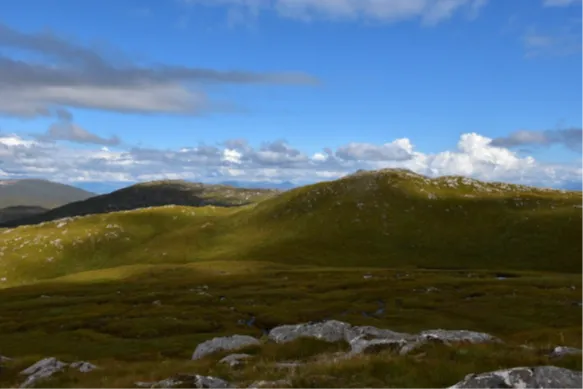
This project will seek to improve the understanding of the evolving nature of wildfire risk in Scotland [1]. This topic will be studied in the particular context of understanding and improving wildfire resilience in natural capital sites (e.g. woodland creation, peatland restoration).
Through a mixed methods approach, this study will explore historic and predicted future wildfire trends in Scotland, alongside mapping and evaluating the key views and concerns of keys stakeholders including land managers, government bodies and the general public. This will seek to provide improved understanding of the overall risk profile at a national and regional level, as well as the evolving nature of wildfire resilience of landscapes throughout different stages of the restoration process and in response to different interventions (e.g. grazing, creation of firebreaks, rewetting etc.).
The project will include systematic review of existing UK-focused wildfire trend studies, along with a review of existing approaches to wildfire management in natural capital sites particularly in the UK. This will be followed by stakeholder view mapping to understand existing attitudes to wildfire risk across stakeholder groups and to produce a roadmap to provide a ranked indication of key priority areas for improved data collection, use and modelling tools to support wildfire risk assessment practices and allow evidence-based risk mitigation interventions to be implemented. This will be informed by existing data and additional survey data collection from both UoE and Ardtornish sites [2] and will draw on the land management expertise of these project partners, and the input of other key stakeholders to help shape the project focus.
[1] Wildfire risks to UK landscapes. UK Parliament POSTnote 717. (April 2024) https://researchbriefings.files.parliament.uk/documents/POST-PN-0717/POST-PN-0717.pdf
[2] Forest & Peatland Programme, The University of Edinburgh. [Online] https://sustainability.ed.ac.uk/operations/forest-peatland
Full Project Details can be found here:
The PhD student will be join a larger, existing cohort of PhD projects supported by the University’s Forests and Peatland Programme that aims to advance our understanding of the impacts, and monitoring and reporting
techniques, around woodland creation and peatland restoration initiatives, which are designed and managed to meet multiple objectives, across different sites in Scotland.
Support will also be provided by the multi-disciplinary research supervision team, and the student will also join a cohort of PhD students and Post-Doctoral Researchers at the internationally recognised Edinburgh Fire Research Centre. Relevant training will be provided however experience and/or willingness to combine a mix of computational modelling and lab/fieldwork is required
How to Apply
The ‘Apply Now’ button will take you to the School of Engineering PhD Programme Application Portal. To apply for this project, please select ‘Full Time PhD Engineering (3 Years)’ from the dropdown list for ‘Select Programme’. Please note that 4 years of full funding will be provided but all PhD degrees at UoE are structured as 3 years + an additional year for writing up the PhD thesis (regardless of length of funding).
The intended start date for the project is July 2026, but there may be some flexibility for suitable candidates.
As part of your application, include the name of Dr Zakary Campbell-Lochrie in the application form and personal statement, and discuss your motivation for doing a PhD and what attracts you to this PhD position in particular. In the application title and ‘Finance’ section of the application, add “Understanding evolving wildfire risk and resilience in Scotland – Funded Project”. Please also make sure to include your most up-to-date CV as part of the application submission, a Research Proposal does not need to be submitted at this time.
For any issues or questions please contact Dr Zakary Campbell-Lochrie (Z.Campbell.Lochrie@ed.ac.uk).
Essential:
A minimum 2.1 degree in Environmental Engineering, Geosciences, Environmental Science, Ecology or Other Relevant Subject. A Master’s degree in in Environmental Engineering, Geosciences, Environmental Science, Ecology or Other Relevant Subject.
The project is available to UK/International citizens. The candidate must meet the English qualification requirements as described at: Further information on English language requirements for EU/Overseas applicants.
· Experience and passion for collecting field data.
· Experience and enthusiasm for quantitative data analysis.
· Enthusiasm working with stakeholders and understanding different needs and perspectives
Desirable:
· A UK driving licence for field work.
· Experience in GIS and remote sensing techniques.
· A working knowledge of R/Python.
· Experience in interdisciplinary approaches, social science techniques.
UKRI level stipend for 4 years, home or overseas fees, £5k research costs (over the duration of the project).
Bridges in the UK are facing increasing challenges due to aging infrastructure and changing environmental and climate conditions. Rising temperatures, increased rainfall, flooding, and more frequent extreme weather events are expected to accelerate deterioration processes and place additional pressure on bridge asset management systems. At the same time, large volumes of inspection and condition data are routinely collected but are not fully exploited for long-term prediction and decision support.
This PhD project focuses on the development of data-driven digital twin approaches to improve the prediction of climate-driven deterioration in UK bridges. The research will explore how historical bridge inspection records, condition ratings, maintenance data, and environmental or climate exposure information can be integrated to support more reliable condition forecasting. The work will investigate data-driven and hybrid modelling approaches that combine engineering understanding with machine learning techniques, while also considering uncertainty and data limitations.
The project will be jointly supervised by Dr Yavuz Yardim (University of Edinburgh) and Dr Demetris Cotsovos (Heriot-Watt University), leading to a joint PhD degree from the University of Edinburgh and Heriot-Watt University. The candidate will benefit from access to expertise and facilities across both institutions and will work on research questions that are directly relevant to real-world bridge engineering and infrastructure management practice.
There may also be opportunities to engage with industry partners and real infrastructure datasets.
The exact research direction will be refined with the successful candidate, depending on their background and interests.
Candidate Profile: We seek a highly motivated individual with:
- A 2:1 undergraduate degree (or equivalent) in civil engineering, structural engineering, data science, computer science, or a closely related discipline.- Strong programming and data analysis skills (e.g. Python).- Demonstrated experience in machine learning or data-driven modelling.- An interest in bridges, infrastructure systems, and climate-related deterioration.- The ability to work independently and as part of a multidisciplinary research team.
Applications are welcomed from self-funded students, or students who are applying for scholarships from the University of Edinburgh or elsewhere
Further information and other funding options.
Tuition fees + stipend are available for applicants who qualify as Home applicants.
Tuition fees + stipend are available for applicants who qualify as Home applicants (International students can apply, but the funding only covers the Home fee rate)
Funding Details:
Duration: 42 months (3.5 years)
Start date: Flexible, but no later than July 2027
Stipend: Enhanced above UKRI standard rate
Research & Training Grant: £5,000 (UoE) or £3,500 (HWU)
Between 1853 and 2020, approximately 25 billion tonnes of coal were extracted from sites across the UK, leaving behind extensive subsurface voids as the majority of these mines have since ceased operation. Today, the UK hosts around 23,000 abandoned coal mines, all of which require ongoing management by the Mining Remediation Authority due to the cessation of dewatering activities. These vast underground void spaces represent a significant yet underexplored opportunity for large-scale thermal energy storage. Owing to the historical concentration of fossil-fuel industries during the Industrial Revolution, nearly 90% of the UK’s largest urban areas are situated above former mining zones, leading to a unique geographic overlap between locations of high heat demand and potential heat storage capacity. These same urban areas are also major sources of waste heat, suggesting strong potential for thermal energy storage. This PhD project proposes that abandoned coal mines can be fully repurposed as long-term thermal energy storage reservoirs, and aims to rigorously evaluate their technical feasibility.
The specific objectives are to: (i) develop a robust conceptual and numerical model of heat storage processes in flooded mine environments using COMSOL Multiphysics; (ii) integrate the model with representative UK mine geometries and geological settings; and (iii) conduct scenario-based simulations to identify the controlling thermal–hydraulic processes and assess the practical feasibility of mine-based thermal energy storage systems. The project will be undertaken in full collaboration with TownRock Energy, who will support the research through co-supervision, hosting of the PhD student, and provision of relevant datasets, maps, and software tools. Informal queries from potential applicants can be directed to Dr Melis Sutman (melis.sutman@ed.ac.uk).
Essential Background: - 2.1 or above (or equivalent) in civil engineering, geotechnical engineering, engineering geology or any other closely related subjects. Desirable Background: - An MSc/MEng degree on shallow geothermal energy technologies or mine water geothermal energy - Familiarity with numerical modelling tools such as COMSOL Multiphysics or FEFLOW. - Understanding of heat and mass transfer processes in porous or fractured media.
Further information on English language requirements for EU/Overseas applicants.
Applications are welcomed from self-funded students, or students who are applying for scholarships from the University of Edinburgh or elsewhere as well as self-funded students.
Competition (EPSRC) funding may be available for an exceptional candidate. Link below for the further details.