
Image

Dr Jonathan G. Terry is the Deputy Head of the Engineering Graduate School at the University of Edinburgh. He joined the School of Engineering in early 1999 as a Post-doctoral Research Associate and later became a Chancellor’s Fellow. He currently lectures in the Electrical and Electronic Engineering Discipline teaching undergraduate students in the 1st, 3rd, and 4th year, as well as those within the MSc Electronics programme.
He is based in the Institute for Integrated Micro and Nano Systems, where his current research activities are in the production of smart sensor systems, exploiting the extensive toolset in place at the fabrication facilities of the Scottish Microelectronics Centre. These involve the development and use of novel fabrication processes and materials, and their integration with post-processed foundry CMOS circuitry. To date, his research has included the development of sensing systems for physical, biological, chemical, medical, astronomical and harsh environment applications.He is a named inventor on three patents and has authored over a hundred journal and conference publications.
Recent and current funded research projects include:

Istvan Gyongy received the M.Eng. and Ph.D. degrees from the University of Oxford, UK, in 2003 and 2008, respectively. Following a period in industry, where he worked on processors for smartphones and a cloud-connected activity tracking system for dairy farms, he joined the University of Edinburgh. His initial research at the University was on hydrodynamic modelling relating to the development of FloWave, the combined wave and current test facility. His research is now focused on the development of single-photon avalanche diode (SPAD) cameras and their application in a range of domains including LIDAR and the life sciences.
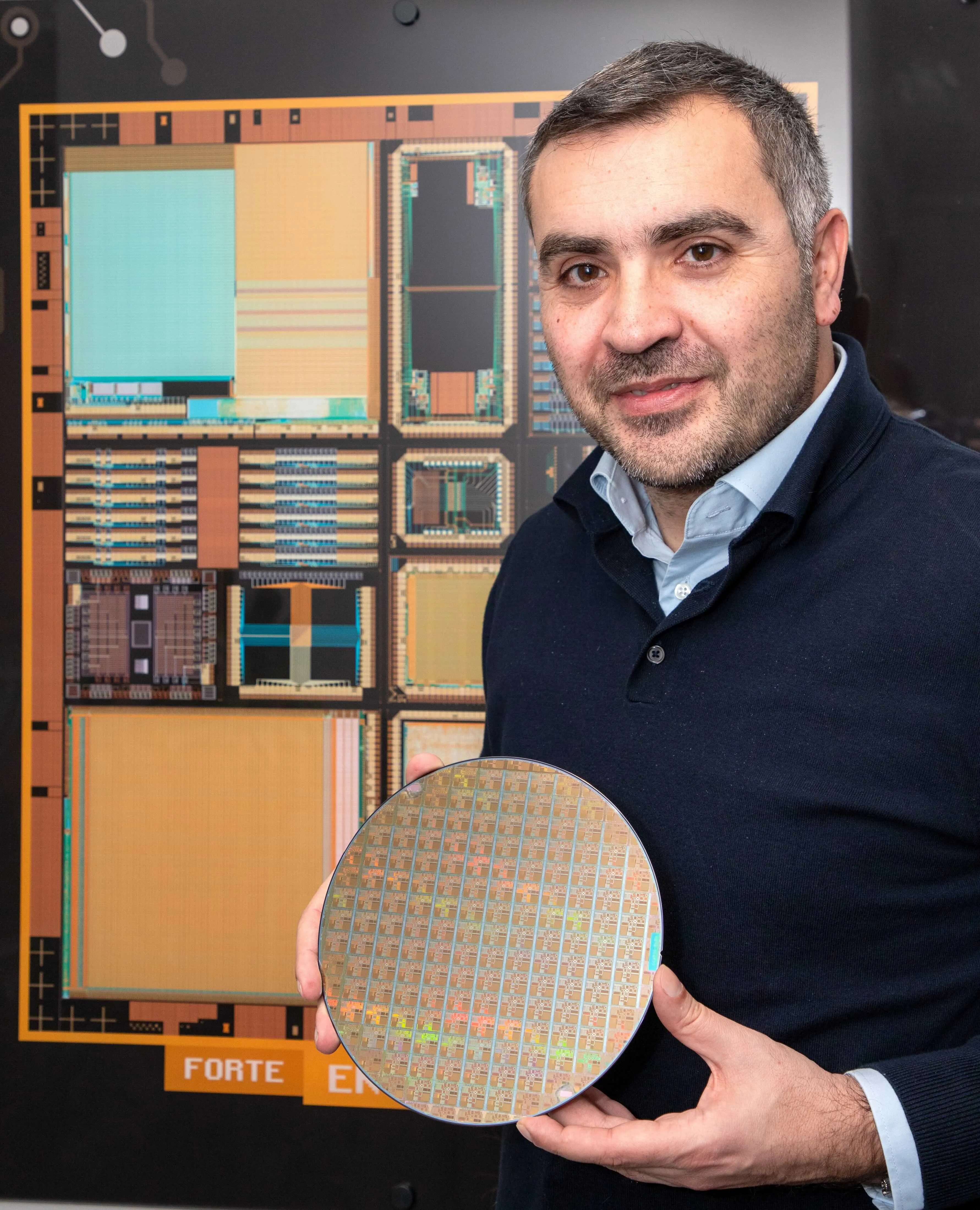
Themis holds the Regius Chair of Engineering at the University of Edinburgh where he established the Centre for Electronics Frontiers (CEF) and is currently the Head of the Institute for Integrated Micro and Nano Systems (IMNS) that also hosts the Scottish Microelectronics Centre (SMC). His work focuses on developing energy-efficient AI hardware solutions through innovating novel semiconductor technologies and neuromorphic computing architectures. He leads an interdisciplinary team comprising researchers with expertise across materials process development to electron devices and circuits and systems for applications in embedded systems and AI.
He holds a Royal Academy of Engineering Chair in Emerging Technologies and is an Adjunct Professor at UTS Australia and Honorary Fellow at Imperial College London. He is Fellow of the Royal Society of Chemistry, the British Computer Society, the IET, the Institute of Physics and member of Academia Europaea. He is the Director of the UKRI APRIL AI Hub that is developing AI tools and capabilities for the electronics sector. He also served as the Director of the Lloyds Register Foundation International Consortium for Nanotechnology and Co-Director of the UKRI Centre for Doctoral Training in Machine Intelligence for Nanoelectronic Devices and Systems (MINDS).
In 2015, he established ArC Instruments Ltd that delivers high-performance testing infrastructure for automating characterisation of novel nanodevices in over 26 countries and in 2025 he founded EVA that is building new power-efficient AI hardware solutions. His contributions in memristive technologies and applications have brought this emerging technology one step closer to the electronics industry for which he was recognised as a 2021 Blavatnik Award UK Honoree in Physical Sciences and Engineering and with the Royal Academy of Engineering Princess Royal Silver Medal in 2025.
PhD in Electrical and Electronic Engineering, “Application of Maxwell-Wagner Polarisation in Monolithic Technologies”, Imperial College London, UK.
MSc in Microelectronics and Telecommunications, University of Liverpool, UK.
BEng in Electrical and Electronic Engineering, University of Lincoln, UK.
Member Academia Europaea
Fellow Member (FBCS), The British Computer Society
Fellow Member (FRSC), The Royal Society of Chemistry
Fellow Member (FInstP), The Institute of Physics
Fellow Member (FIET), The Institution of Engineering and Technology
Member of the American Nano Society (ANS)
Member, Institute of Neuromorphic Engineering (IME)
Senior Member (SMIEE), Institute of Electric and Electronic Engineers
PGEE11195 - Engineering Research Methods with Grand Challenge
PGEE11038 - Microfabrication Techniques
Emerging Semiconductor Technologies for sustainable AI Hardware solutions (see Ingenia cover on his work as RAEng Chair in Emerging Technologies).
AI tools/capabilities for enhancing innovations in electronics and semiconductor technologies (see work as Director of the UKRI APRIL AI Hub).
AWARDS
2026 Honorary Doctorate, Department of Physics at the University of Patras, Greece
2026 Community Award (Highly Commended), APRIL AI Hub, RAI AI & Robotics Awards
2025 Princess Royal Silver Medal, Royal Academy of Engineering
2021 Blavatnik Award for UK Young Scientists in Physical Sciences & Engineering
2020 Chartered Engineer (CEng), Engineering Council
2019 Royal Academy of Engineering Chair in Emerging Technology – AI Hardware
2018 University Research Group of the Year finalist, TechWorks Awards
2018 University Research Award finalist: Memristor record, Elektra Awards
2017 Royal Society Industry Fellowship
2017 Lloyd’s Register Foundation 100A1 ambassador
2013 EPSRC Early Career Fellowship
2010 Lindemann Trust Fellowship
2008 Corrigan Foundation and LSI Inc. Fellowship in Nanoscale Science & Technology
2006 The A.G. Leventis Foundation Scholar
INSTITUTIONAL RESPONSIBILITIES
2026 – Head of Institute for Integrated Micro & Nano Systems, University of Edinburgh, UK
2024 – Data Driven Innovation (DDI) Programme Strategy Board, University of Edinburgh, UK
2022 – 2026 Director of Centre for Electronics Frontiers, University of Edinburgh, UK