
Image
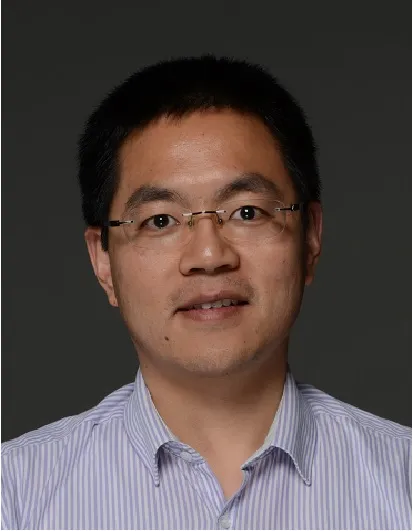
I joined the University of Edinburgh (UoE) in 2021 as a Senior Lecturer in Chemical Engineering. I studied chemical engineering at the Nanjing University of Technology, obtaining a BEng with Highest Distinction in 2003 and PhD in 2008. In the last year of my PhD, my first employment started at The University of Hong Kong (Department of Chemistry). The next position was at the Ludwig-Maximilians-Universität München (Department of Physics) from 2010 to 2013 a. Early 2013, I moved to the University of Liverpool (Department of Physics) and assisted to set up a new research group. Before I joined UoE, I had a four-month spell working in the National Graphene Institute, University of Manchester, and five-year experience as Lecturer in Chemical Engineering, Aston University.
2016 Postgraduate Certificate in Learning and Teaching for Higher Education in the UK. 2003-2008 Nanjing University of Technology (NJUT), PhD in Chemical Engineering. 1999-2003 NJUT, BEng (1st Honours) in Chemical Engineering.
IChemE, RSC, EPSRC Associate Peer Review College
Chemical Engineering Design 4 (CHEE10010) - Course Organiser
Supervising students' projects in various chemical engineering courses: Study Project 4, Research Project 5, etc.
1. Over 10 years’ expertise in nanomaterials, photocatalysis, greenhouse gas removal, reaction engineering, electrochemistry and physical chemistry. 2. Extensive practices on preparation and characterization of nanomaterials, design and evaluation of photocatalytic reactions/photoreactors, antimicrobial properties of nanomaterials. 3. Leading multidisciplinary projects involving both academic and industral resources, comprehensive collaboration and interpersonal skills in a team environment. 4. Skills in electron microscopy, time-resolved spectroscopy, thermal analysis, chromatography, atomic force microscopy, X-ray crystallography and synchrotron radiation spectroscopy
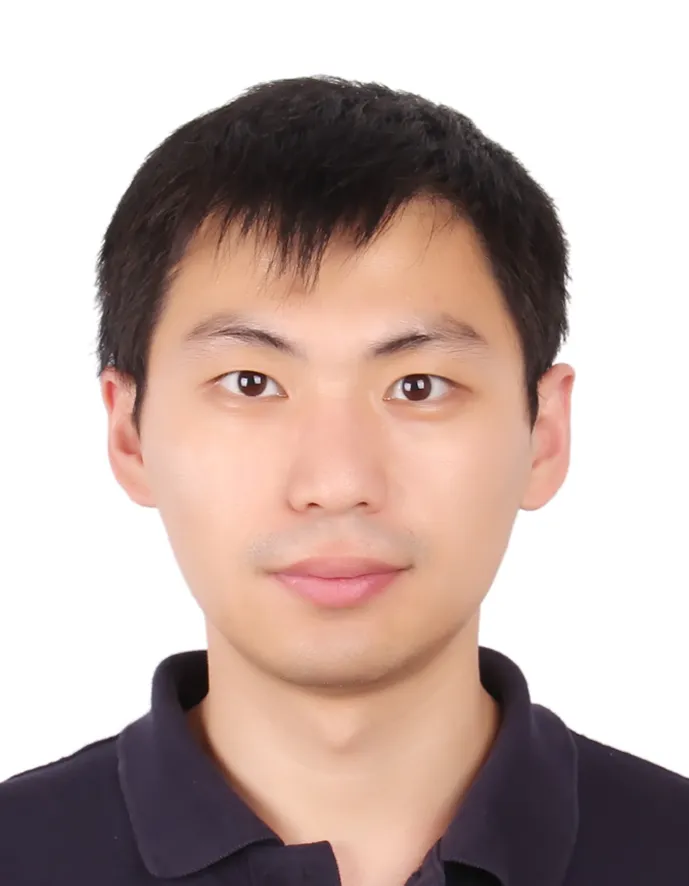
Dr Nan Yu is a Senior Lecturer/Associate Professor at the University of Edinburgh, and the Deputy Director of MSc Digital Design and Manufacture.
Nan was trained at Cranfield University (PhD: plasma figuring of large optics), University College Dublin (UCD, as a postdoc in precision manufacturing of medical devices), and the European Organisation of Nuclear Research (CERN, as an Associate Scientist in precision alignment and metrology). He has established academic reputation in precision manufacturing and advanced plasma technologies as evidenced by over £ 1 M funding secured as PI, more than 50 papers in peer-reviewed journals and conferences, 4 paper awards and 10 invited/keynote talks. Nan receives the prestigious Marie Curie International Fellowship (2018-2020), Irish Research Council Fellowship (2020), and Royal Academy of Engineering Industrial Fellowship (2023-2024). He holds two visiting appointments at UCD (2021-2026) and Osaka University (2022-2024).
PgCAP in Higher Education (2023), Edinburgh
PhD in Precision Engineering (2017), Cranfield
MSc in Mechanical Manufacturing (2013), Harbin;
BSc in Mechanical Engineering (2011), Harbin;
2018 Professional Certificate of Entrepreneurial Educators, UCD, National University of Ireland;
2018 International Scientific Committee member of European Society for Precision Engineering and Nanotechnology (EUSPEN);
2019 Member of International Academy of Engineering and Technology (AET);
2021 Research Affiliate of International Academy of Production Engineering (CIRP);
2021 Member of EPSRC Early Career Forum in Manufacturing Research;
2022 Fellow of Royal Society for Art, Manufacture and Commerce (RSA);
2023 Fellow of Higher Education Academy (HEA)
1. Conceptual Design for Mechanical Engineers 3 (Course Organiser);
2. BEng Mechanical Engineering Project 4;
3. Digital Manufacturing 5;
4. Metrology in MSc Digital Design and Manufacture (Course Organiser)
5. MEng Mechanical Engineering Project 5
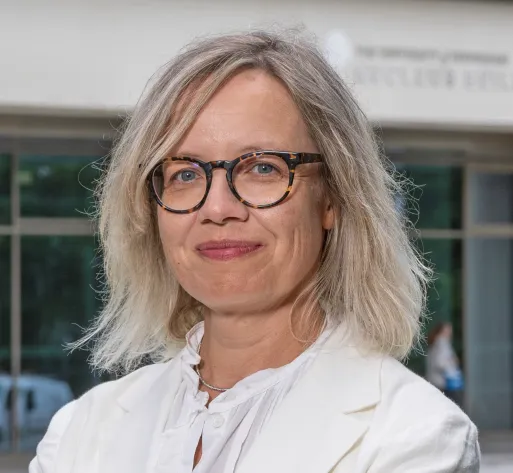
Maria Grazia De Angelis is a Full Professor of Chemical Engineering Principles at the University of Bologna and an Honorary Professorial Fellow at the University of Edinburgh (UK), where she leads the SusProm Group. Her research is dedicated to the design of products (biodegradable packaging, selective membranes) and sustainable processes (CO2 capture, water purification, wearable hemodialysis). She is currently engaged in integrating various theories, including AI, to enhance the capability of designing materials for separation.
She is the Chair of the Working Party on Thermodynamic and Transport Properties of the European Federation of Chemical Engineers (2022-2028). She was the Vice President of the European Membrane Society (2019-23). She is a co-author of more than 100 publications in international journals in the field of membrane science, thermodynamics, and computational material science (Google Scholar).
She has been a Researcher or Visiting Professor at
Go to the Group SusProM Website
Senior Fellow of the Higher Education Academy (SFHEA)
Associate Member of IChemE Member of AIDIC (Italian Association of Chemical Engineering) Member of European Membrane Society Member of AIChE
-Member of the Editorial Board of Membranes and Fluid Phase Equilibria
-Editor of the Special Issue "Fundamentals of Transport in Polymers and Membranes—Honorary Issue for Professor Giulio C. Sarti" 2022
-Editor of the Special Issue "Gas Transport in Glassy Polymers" 2020-2021
-Watch my webinar “Membranes for CO2 Capture: Thermodynamic aspects” given during the EFCE Spotlight Talks, December 3rd 2020. Organized by the European Federation of Chemical Engineers. -Host of the European Membrane Society Live Webinars Series, watch them on Youtube
The design of all chemical process starts from mathematical modelling and computational thermodynamics. The reliability of a thermodynamic model in predicting or correlating phase equilibria depends strongly on the value its parameters. Carefully evaluated parameters enable a precise calculation of the phase equilibria and of the process units, affecting as a consequence the costs of a chemical process.
In several cases, the thermodynamic parameters commonly used in process simulators are wrong. They do not return a comprehensively right equilibrium.
The project focuses on the development of an open tool for the correct regression and correlation of thermodynamic data in robust mathematical models. The project involves the development and use of optimization techniques. Special modelling, including Bayesian regression or similar techniques, will be also used.
In this project, you will design digital open and user-friendly tools that can easily integrate with existing process simulators (e.g. AspenPlus, Unisim) and exploit recent advanced algorithms [1, 2]. The ambition of this project is to earn the sector’s support and enable the widespread use of the tool in place of the current unreliable counterparts.
You will work in the Emerging Sustainable Technologies Laboratory (ESTech Lab) [3], be part of a world leading research group in sustainable technologies towards the development of the first robust tool for thermodynamic model identification and calibration, have access to state-of-the-art computing facilities and brainstorm new digital tools across all thermodynamic problems.
Your studies will be carried out at the Institute for Materials and Processes (IMP) and could include occasional experiments to validate models. You will attain skills in modelling, design and testing of innovative digital tools.
Please note, the position will be filled once a suitable candidate has been identified.
[1] https://www.sciencedirect.com/science/article/pii/S037838121400226X
[2] https://www.sciencedirect.com/science/article/pii/S0378381220300297
Minimum entry qualification - an Honours degree at 2:1 or above (or International equivalent) in a relevant science or engineering discipline, possibly supported by an MSc Degree. As well as:
Further information on English language requirements for EU/Overseas applicants.
Desirable criteria:
A number of scholarships are available to competitive candidates. For more information on the funding application process, please contact the project’s supervisor or visit the School of Engineering website.
Applications are also welcomed from self-funded students.
The design of the forthcoming future is negative in emissions. Among the negative emission technologies options, those capturing CO2 directly from the air are called Direct Air Capture technologies. Direct Air Capture technologies are regarded as the solution having the biggest carbon removal potential but is also the least known. If Direct Air Capture had to be an essential measure, future society would deal with severe restrictions in energy availability [1].
However, using the captured atmospheric CO2 for conversion into chemicals and fuels has the right scale not to impinge in the energy system and attractive economic outlook.
In your studies you will work in the Emerging Sustainable Technologies Laboratory (ESTech Lab) [2], be part of a world leading research group in carbon capture towards the development of technological avenues for Direct Air Capture and Conversion into chemicals and fuels.
Your studies will be carried out at the Institute for Materials and Processes (IMP) and will include modelling activities. You will attain skills in modelling and design of new negative emission technologies and production paths.
Please note, the position will be filled once a suitable candidate has been identified.
[1] Santori et. al. Adsorption artificial tree for atmospheric carbon dioxide capture, purification and compression, Energy 162 (2018) 1158-1168. https://doi.org/10.1016/j.energy.2018.08.090
Minimum entry qualification - an Honours degree at 2:1 or above (or International equivalent) in a relevant science or engineering discipline, possibly supported by an MSc Degree. As well as:
Further information on English language requirements for EU/Overseas applicants.
Desirable criteria: knowledge of optimization methods.
A number of scholarships are available to competitive candidates. For more information on the funding application process, please contact the project’s supervisor or visit the School of Engineering website.
Applications are also welcomed from self-funded students.
Digital tools are omnipresent and their rise exponential. Cloud and digital services have improved our lives and, overall, reduced carbon emissions, although at the expense of a growing electricity demand from data centres. Remarkably, nearly half the data centre electricity input is for self-cooling, which provides an opportunity for a technology able to harness low-grade heat and turn it into cooling power. The co-location of energy in form of heat and water is an opportunity.
The project focuses on the mathematical modelling and optimization of a proof-of-principle heat-powered cooling process that reduces waste heat and greenhouse gas emissions and boosts return on investment, while meeting all the sustainability criteria.
Special modelling, including machine learning, and cost of manufacturing tools guide the development of an optimised heat-to-cold concept designed to break through current barriers to commercialisation.
In this project, you will design digital tools for an innovative technology that uses low temperature heat for the production of cold by exploiting recent discoveries in material science and engineering [1, 2]. The ambition of this project is to earn the sector’s support and enable the widespread use of heat-powered cooling in place of the current electricity-driven counterpart.
You will work in the Emerging Sustainable Technologies Laboratory (ESTech Lab) [3], be part of a world leading research group in sustainable technologies towards the development of a proof-of-concept super-efficient processes for heat-powered cooling, have access to state-of-the-art computing facilities and brainstorm new technological avenues for cooling.
Your studies will be carried out at the Institute for Materials and Processes (IMP) and could include occasional experiments to validate models. You will attain skills in modelling, design and testing of innovative technologies for cooling.
Please note, the position will be filled once a suitable candidate has been identified.
[1] https://onlinelibrary.wiley.com/doi/full/10.1002/ente.202300548
Minimum entry qualification - an Honours degree at 2:1 or above (or International equivalent) in a relevant science or engineering discipline, possibly supported by an MSc Degree. As well as:
Further information on English language requirements for EU/Overseas applicants.
Desirable criteria:
A number of scholarships are available to competitive candidates. For more information on the funding application process, please contact the project’s supervisor or visit the School of Engineering website.
Applications are also welcomed from self-funded students.
Digital tools are omnipresent and their rise exponential. Cloud and digital services have improved our lives and, overall, reduced carbon emissions, although at the expense of a growing electricity demand from data centres. Remarkably, nearly half the data centre electricity input is for self-cooling, which provides an opportunity for a technology able to harness low-grade heat and turn it into cooling power. The co-location of energy in form of heat and water is an opportunity.
The project focuses on the design and demonstration of a proof-of-principle 3D printed heat-powered cooling device that reduces waste heat and greenhouse gas emissions and boosts return on investment, while meeting all the sustainability criteria.Special characterisation techniques and additive manufacturing tools guide the development of a geometrically-optimised heat-to-cold concept which is designed to break through current barriers to commercialisation.
In this project, you will research and develop an innovative technology that uses low temperature heat for the production of cold by exploiting recent discoveries in material science and engineering [1, 2]. The ambition of this project is to earn the sector’s support and enable the widespread use of heat-powered cooling in place of the current electricity-driven counterpart.
You will work in the Emerging Sustainable Technologies Laboratory (ESTech Lab) [3], be part of a world leading research group in sustainable technologies towards the development of a proof-of-concept super-efficient processes for heat-powered cooling, have access to state-of-the-art equipment including rapid prototyping tools and brainstorm new technological avenues for cooling.
Your studies will be carried out at the Institute for Materials and Processes (IMP) and will include modelling activities supported by experiments. You will attain skills in modelling, design and testing of innovative technologies for cooling.
Please note, the position will be filled once a suitable candidate has been identified.
[1] https://onlinelibrary.wiley.com/doi/full/10.1002/ente.202300548[2] https://pubs.acs.org/doi/10.1021/acs.est.9b06037[3] https://www.linkedin.com/in/giulio-santori-a365546/
Minimum entry qualification - an Honours degree at 2:1 or above (or International equivalent) in a relevant science or engineering discipline, possibly supported by an MSc Degree. As well as:
Further information on English language requirements for EU/Overseas applicants.
Desirable criteria:
A number of scholarships are available to competitive candidates. For more information on the funding application process, please contact the project’s supervisor or visit the School of Engineering website.
Applications are also welcomed from self-funded students.
Climate change is already exacerbating water scarcity bringing uncertainty in the future of the water availability vs. abstraction (water stress), especially in delicate eco-systems. At the same time, industry highly relies on water. In most of the water-demanding industrial sectors high water demand is co-located with high energy demand (water-energy nexus), similarly to countries that benefit from high solar thermal energy (high energy availability) and at the same need water. The co-location of energy in form of heat and water is an opportunity.
In this project, you will research and develop advanced dynamic mathematical models of an innovative technology that uses low temperature heat for the production of water with different quality (from drinkable to industry and agriculture). The technology will be powered by ultralow energy and exploit the temperature differences available in nature: air, soil and natural water (e.g. lakes, seas, rivers).
You will work in the Emerging Sustainable Technologies Laboratory (ESTech Lab) [1], be part of a world leading research group in sustainable technologies towards the development of user-friendly (Graphical User Interface) advanced model for the characterization and prediction of the dynamic performance of heat-powered clean water production (e.g. desalination), have access to state-of-the-art computing facility and brainstorm new technological avenues for clean water production.
Your studies will be carried out at the Institute for Materials and Processes (IMP) and will include short experimental activities to validate your models. You will attain skills in modelling, design of innovative technologies for clean water.
Please note, the position will be filled once a suitable candidate has been identified.
Minimum entry qualification - an Honours degree at 2:1 or above (or International equivalent) in a relevant science or engineering discipline, possibly supported by an MSc Degree. As well as:
Further information on English language requirements for EU/Overseas applicants.
Desirable criteria: knowledge of computational thermodynamics of fluid phase equilibria or physical chemistry.
A number of scholarships are available to competitive candidates. For more information on the funding application process, please contact the project’s supervisor or visit the School of Engineering website.
Applications are also welcomed from self-funded students.
Climate change is already exacerbating water scarcity bringing uncertainty in the future of the water availability vs. abstraction (water stress), especially in delicate eco-systems. At the same time, industry highly relies on water. In most of the water-demanding industrial sectors high water demand is co-located with high energy demand (water-energy nexus), similarly to countries that benefit from high solar thermal energy (high energy availability) and at the same need water. The co-location of energy in form of heat and water is an opportunity.
In this project, you will research and develop an innovative technology that uses low temperature heat for the production of water with different quality (from drinkable to industry and agriculture) by exploiting recent discoveries in material science and engineering [1, 2]. The technology will be powered by ultralow energy and exploit the temperature differences available in nature: air, soil and natural water (e.g. lakes, seas, rivers).
You will work in the Emerging Sustainable Technologies Laboratory (ESTech Lab) [3], be part of a world leading research group in sustainable technologies towards the development of a proof-of-concept super-efficient processes for heat-powered clean water production (e.g. desalination), have access to state-of-the-art equipment including rapid prototyping tools and brainstorm new technological avenues for clean water production.
Your studies will be carried out at the Institute for Materials and Processes (IMP) and will include modelling activities supported by experiments. You will attain skills in modelling, design and testing of innovative technologies for clean water production.
Please note, the position will be filled once a suitable candidate has been identified.
[1] https://patentscope.wipo.int/search/en/detail.jsf?docId=WO2025003650&_cid=P20-MAL3RA-15255-1
Minimum entry qualification - an Honours degree at 2:1 or above (or International equivalent) in a relevant science or engineering discipline, possibly supported by an MSc Degree.
Further information on English language requirements for EU/Overseas applicants.
Desirable criteria:
A number of scholarships are available to competitive candidates. For more information on the funding application process, please contact the project’s supervisor or visit the School of Engineering website.
Applications are also welcomed from self-funded students.